0.15.5 and since: wave defense and the city at night
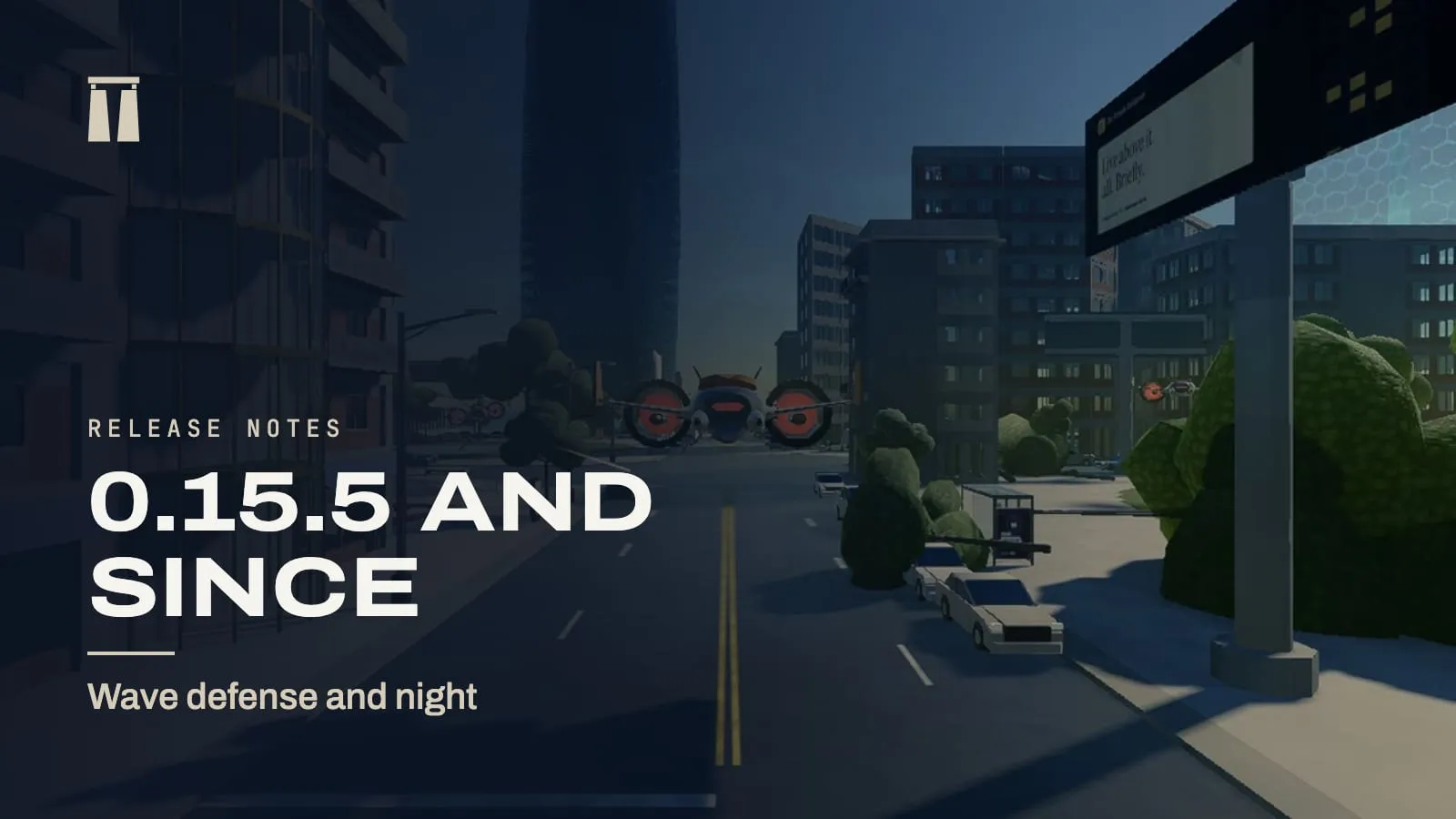
We tagged release 0.15.5 on October 10. It carries what Since 0.15 described and the items in its section below. Everything after that section is in the development build as of the morning of October 12 and is not tagged yet, so some of it may change before the next release.
Three posts from October 11 cover other parts of this work: the enemies’ new moves and attack turns, the wall bumps, and the Brute’s scatter gun, the Sniper’s weapons and the shield. This post leaves those out.
Release 0.15.5
- The player flies one of three classes: the Skyhammer, the Brute and the Sniper. A selection screen after the game mode shows each ship turning, with bars for its speed, agility, armor and firepower. The pick is kept and flown in the sandbox too.
- The Brute carries four missiles that reload in 6 s each and locks in 1.5 s out to 220 m. The Sniper carries two that reload in 7 s and locks in 1.8 s out to 400 m.
- A full-screen loading screen names where the player is going (for a run, the city’s number of seven, its kind and its enemies), shows their ship turning on the right, and moves a bar through the city’s build steps.
- A run’s seven levels now mix the four core cities: tight, mixed, downtown and wide. Each appears at least once and never twice running. The mix comes from the run’s seed, so a run can be flown again.
- The run’s boss is a larger assault craft, 1.75 times the gunship’s size and 29.5 t, as a stand-in until its model is made. With the player ahead of it between 30 and 150 m, it fires a barrage of 8 unguided rockets 0.067 s apart, then reloads for 7 s. Below half its hull it stops retreating and commits to the attack.
- The training ground opens from the Start menu with five lanes: Familiarization, Static, Moving, Reactive and Crossfire. In the last two, drones fire back with simulated rounds. A hit costs 2 s on the lane’s score and never harms the ship. Medals go to gold within par, silver within 1.5 times par and bronze within 2.5 times.
- The mixed city’s houses are six suburban types (ranch, Cape Cod, Colonial, split-level, Craftsman bungalow and modern two-storey) with front and side yards, in place of rows of half-timbered houses.
- Broken concrete shows rebar: one bar to every 0.2 m² of cut face, at most 8 a piece, standing out 0.08 to 0.3 m.
- Dust in a big collapse fades out instead of popping. In the 80-storey tower test, 368,484 of 435,387 dust particles had replaced one still on screen. Now 7,876 do.
- A car thrown into water sinks. One thrown in at 18 m/s had ridden 0.59 m above the surface and now settles 0.74 m under it.
- A ship’s collisions show and sound as hits, with blue sparks where the shield holds, sparks and a puff where it doesn’t, and a thud or a clang.
Wave defense
Wave defense is a new mode on the Start menu. The player picks a ship and defends a city through eight waves and then the boss’s wave. The city is tight, mixed, downtown or wide, chosen by seed.
- Each wave has a timer of 60 to 130 s, and when it runs out the next wave arrives whether or not the last one is cleared. Clearing a wave refills the hull and gives a short break, with an announcement of what is coming next.
- The player has three respawns. The defense is lost when half the city is destroyed or the ship goes down a fourth time.
- The HUD shows the wave number, the lives left, the share of the city still standing with a mark where it is lost, and the ships in each wave before it arrives. The results give the time, the share standing, the waves cleared and the lives left.
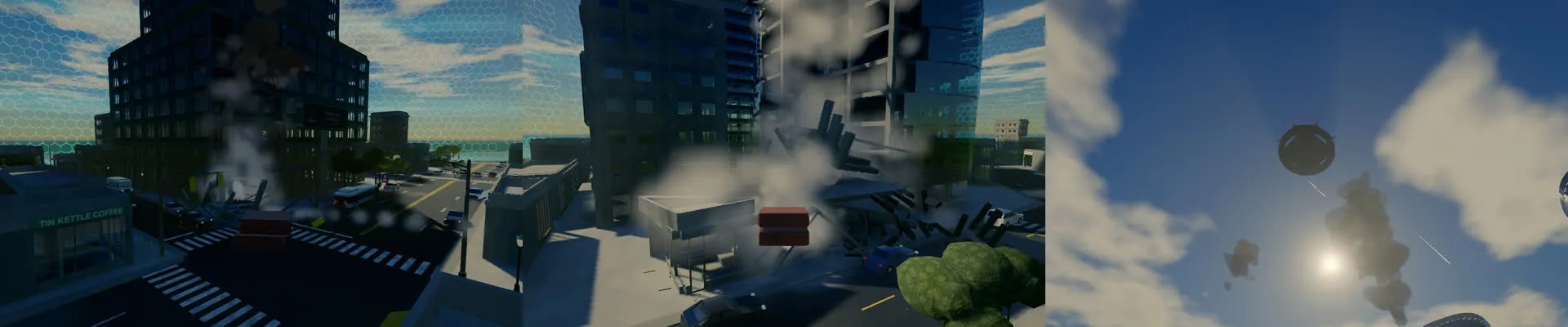
The early waves are swarm drones that ignore the player and go for buildings. Each drone picks a building with the most still standing for its distance, with at most two on any building. It flies there by the streets, holds 30 m off the ground floor and fires disintegrating bolts. What a bolt reaches turns to dust with no pieces left, and the floors above come down under their own load. That keeps the physics cost low. In a test, a bolt at an office’s column removed 9 structural members and left 12 fewer bodies in the scene, where a charge the same size added 325 pieces.
We measured how fast the waves bring a city down with nobody shooting back, and made the bolt smaller and slower: 2.5 m every 3 s in place of 4 m every 1.6 s. With the old bolt, half of each of two tight cities came down in 150 and 160 s. With the new one, one fell at 200 s and the other was not half down after 240 s.
The last wave brings the fortress, a ring 26 m across that weighs 600 t. It warps in over a building and takes out the building’s middle, then hovers 45 m up, or 10 m over the tallest building when that is higher. It holds off one building at a time and fires bolts into its side, moving to the next once half of it is down. Eight turrets on its rim aim at the player and can be shot off one at a time. With all eight it fires 145 rounds in 10 s, and with two left it fires 39. The drones and the fortress are stand-in shapes until their models are made.
Enemies
- An enemy roster is in the development build behind a menu option until we have played it. It has seven kinds of enemy, each one of the player’s classes with one thing changed. The easy ones are the Wasp, the Bruiser and the Picket, none with missiles. The medium ones are the Stinger, the Salvo and the Lancer, each with its own way of firing missiles. The boss is the Warden. A run draws its enemies from the roster by its seed, so runs differ and a run can still be flown again. Each kind flies a stand-in until its model is made.
- Enemies taking a turn to attack come in round the side away from the other attacker, a pincer, unless they are already behind the player. In headless fights, a fifth more attacks came from the player’s blind side, and the player took 7% less damage a minute.
- Cautious enemies waiting for their turn wait behind cover the player can’t see. Four cautious enemies spent 68% of their waiting out of sight, against 24% before.
- The minimap shows only the enemies the ship has found. The ship sees all round to 250 m, through glass but not through buildings, and a lost contact stays on the map for 1.5 s. A scanner pulse every 4 s reaches 300 m and leaves a fading outline where each enemy was, with a soft sonar ping.
- Every enemy in the game now flies the copper Raven, and the old Raven is gone. Enemies no longer spawn inside a structure’s footprint.
- Hard mode puts about one city in four at night: 368 of 1,400 cities over 200 test runs.
A ship’s death
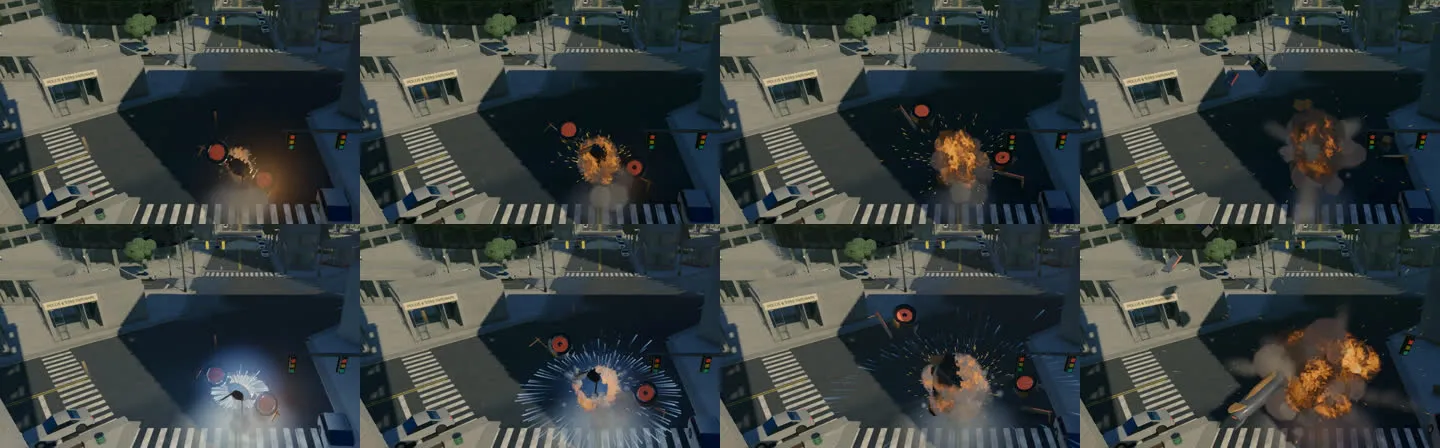
A ship that is shot down now explodes as its fusion core going off. A 6 t ship at rest makes a 3.5 m blast, which scales with the cube root of the ship’s mass and grows up to 1.6 times when the ship is boosting. A gunship’s death is now larger than a ship missile’s blast (3.4 m against 3 m), and beside an office’s ground-floor column it breaks 5 structural members where the old death broke 2. It shows as a blue-white flash, a flat ring of streaks and a shockwave, with the fire 0.07 s behind.
The same work found that missiles and ship deaths in a fight never touched cars or trees. They now set cars burning and snap trees, as the sandbox’s rockets always did.
The city at night
- At night the moon takes the sun’s place, and the sky, light, reflections, fog and shadows follow it. Moonlight is 16% of the sun’s and bluer, and the stars twinkle. The sandbox draws about one city in four at night.
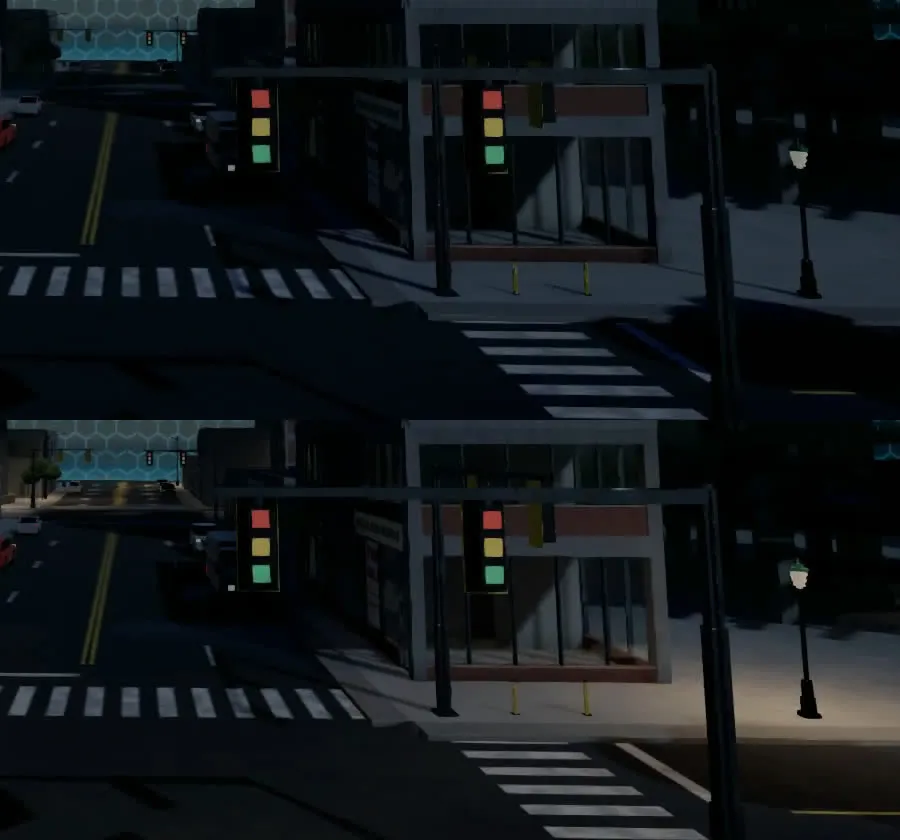
- Street lamps light the street in warm pools. The light is drawn once into a map of the city, and a lamp knocked over goes dark.
- Offices beyond 90 m show lit rooms behind the glass, 30 to 65% of each building’s rooms by its seed.
- Lamp heads, lit panels and LED boards had been clipped to the brightness of their own color. At night they now glow and bloom as designed. A lit sign cabinet went from 2 bright pixels to 902.
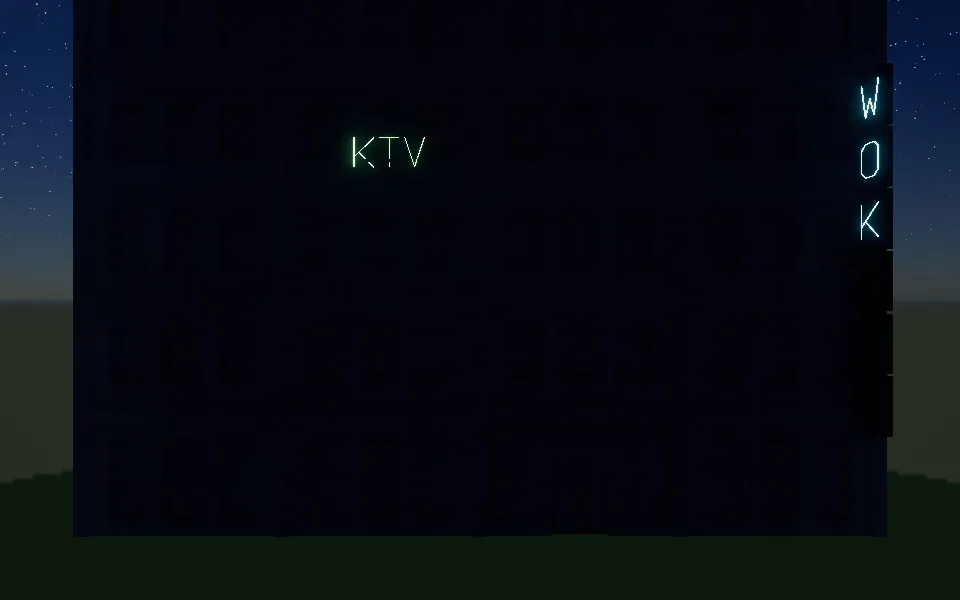
- The neon city is a new sandbox city, always at night with wet streets. Every building in the tall tight city carries neon: vertical blade signs at a building’s end and words across the upper storeys, in a single-line tube lettering. Signs are drawn as trim on the facade, so they add nothing to the physics and fall with whatever they hang on. A tube knocked off bursts in glass and sparks. Seed 7 signs all 136 of its buildings with 7,958 pieces.
- In the tight city, six office towers carry LED video walls two storeys tall across their street faces. A wall is part of its building and comes down with its floors, and a cabinet shot away goes dark.
On the street
- Bus shelters modeled on New York’s standard shelter, 4.27 by 1.52 by 2.72 m, stand on the sidewalks with backlit ad cases. A round breaks the pane nearest it, a blast breaks every pane in reach into tempered pebbles, and a blast or a ship knocks the whole shelter over. A city has 2 to 8.
- Two-sided ad panels stand along the curbs, 7 to 29 a city.
- The walls carry 43 AI-generated graffiti pieces as placeholder art: 17 tags and throw-ups, 6 pieces, 8 wheatpaste bills, 5 stencils and 7 stickers. We’re opening a call for submissions from artists to replace them. Details will follow here when they’re ready.
- Suburban houses have real windows and doors cut into their walls. A pane takes 4 rounds and a door 1, and the room behind is open after. A house now has 54 to 109 structural members where it had 20 to 48.
- A burnt-out car is charred in matte soot, so its hood and roof no longer reflect the sky.
Loading and stalls
- The wide city loads in 3.1 s, where it took 9.7 s. Its ground took 5.8 s and now takes 0.27 s. Each sample of the terrain had been tested against every lot in the city, copying the whole lot each time. The lots are now worked out once and the ground tiles are built on every core. The streets went from 1.60 s to about 0.5 s by building each kind of car and prop once.
- A gunship shot down stalled the game for 290 ms while its wreck was built. Now it takes 12 ms. A respawn spent 113 ms rebuilding the ship’s meshes, and now uses parts made once. Over four minutes of wave defense, the slowest frame went from 294 ms to 85 ms.
- Tidying the scene’s memory in a large city stalled a frame for about 60 ms. It now takes about 25 ms.
Training ground
- Targets on the Static and Moving lanes now hide around corners at street height, slide out for 4 s, then slide back for 4.
- A sixth lane, Section, is over a small downtown. Three enemy pilots fire simulated rounds, two attacking at a time by the pincer while the third waits in cover, with two sentinels. Two couriers fly slow loops and are not targets, and a burst that hits one costs 5 s. Par is two minutes.
- Every lane’s results end with a short debrief: what was flown, which drone landed most of its hits, the longest and quickest waits for a kill, and what was still up if the ship went down.
Controls, menus and sound
- A controller uses one scheme in every mode. The right trigger fires the autocannon and the left fires the ship’s missile. In the sandbox, holding the right bumper opens a weapons wheel with an icon for each weapon.
- The sandbox always flies a ship, and its pause menu can send enemies in waves, by type and skill, 1 to 6 to a wave and 1 to 5 waves.
- The boot sequence opens on the studio’s mark and name, which turn into the engine’s as the night blue comes up.
- One music track plays under the title and menus and fades out as a mode starts.
How this post was made
- Drafted by
- A Claude Code session in the trilithon.games repository, October 12, 2026, working from the game's changelog, dev journal and tracker.
- What it did
- Drafted this post from release 0.15.5 and the unreleased section of the game's changelog, left out what earlier posts cover, and checked each number against the changelog.
- Reviewed by
- Alex van Rossum,
On the roadmap: Training ground, The run: a ladder of cities
Linear MIP2-349, MIP2-423, MIP2-690, MIP2-285, MIP2-286, MIP2-775, MIP2-535, MIP2-543, MIP2-696, MIP2-771, MIP2-697, MIP2-778, MIP2-780, MIP2-548, MIP2-464, MIP2-422, MIP2-748, MIP2-703, MIP2-722, MIP2-756, MIP2-757, MIP2-765, MIP2-760, MIP2-767, MIP2-491, MIP2-459