How tall towers collapse
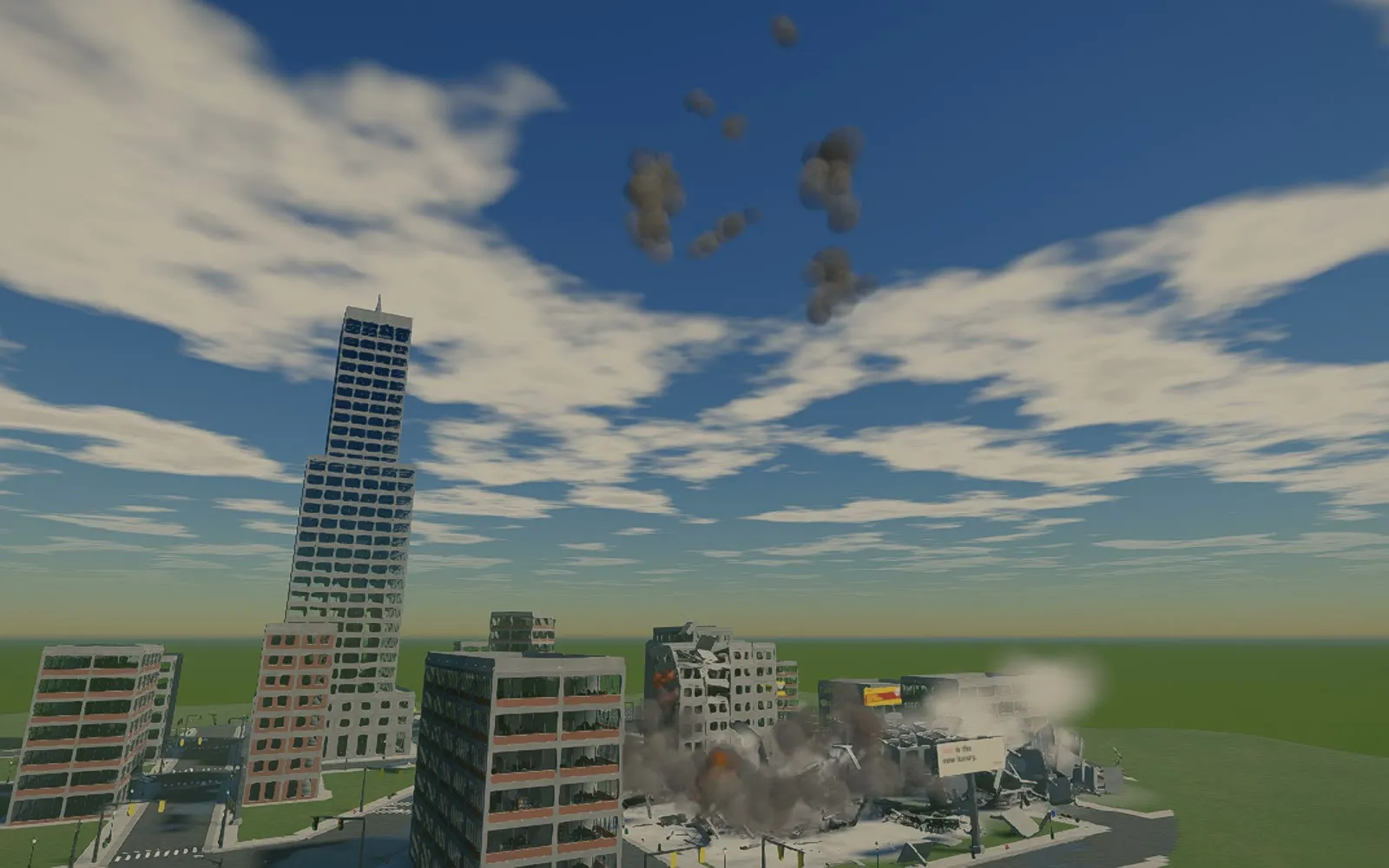
This story runs from September 30 to October 7, 2026. It covers how the game’s tallest buildings come down.
41,884 pieces
When the ground floor of the 160-story test tower was destroyed, the whole tower was cut free at once and fell as 41,884 loose pieces. That is the heaviest case the physics engine has.
We changed how a tall detached section falls. Each story became one driven body that moves straight down, and each story that reaches the ground is crushed to dust and chips. The stories above crush the ones below, so the section comes down as a mass.
The measurements on the 160-story tower, from the first charge until the last story was down:
| Before | After | |
|---|---|---|
| Physics step, median | 197 ms | 0.15 ms |
| Physics step, p95 | 376 ms | 7.9 ms |
The p95 is the step time that 95% of steps stay under. A 40 s benchmark of the tower took 495 s of real time to run before, and takes 25 s now.
It looked like melting
On September 30 the mass was cheap to run, but it came down as if the building were melting, smoothly, with no lean, no panels falling off and no damage showing above the crush line.
The fix sets off random secondary explosions in a building, damaged or not, before it starts to pancake, which is when its floors drop onto each other like stacked pancakes. As a tower starts down, 4 to 6 gas lines go off up the faces toward the camera over the first 1.2 s. A gas line is a small blast inside the structure, and each one blows out the pieces within 8 m. The mass now leans toward the damage, by up to about 8 degrees by the time it is down. Facade pieces peel off the stories above the crush line at 40 a second, glass bursts up the tower at 8 panes a second, and dust jets out of the faces.
The top that breaks off
We also wanted the top of a tall building to be able to break off along the lean and come down on its own, to break more things on the way. We chose to trigger it on the lean and on gas-line damage high up, with a seeded chance.
On a tower of 24 stories or more, the top now breaks at a story in its upper half that has lost a tenth of its pieces, at a gas line that goes off there, or otherwise by chance. It tips over the edge of the break like a felled tree, then is let go as falling blocks.
Downtown, a section also leaned through the part of the building still standing, and a tower that was chipped at never came down story by story and left its top floating. Both were fixed. A story that keeps less than 70% of its columns and core walls now brings down everything above it (40% in buildings under 12 stories).
Three faults, a week later
On October 6, and again on October 7, a partly collapsed tower showed three faults:
- The rubble already lying at its base disappeared when the pancake started.
- Half of the broken-off top shattered, and the other half stopped and then started falling again, as if it had just begun to fall.
- There was a small jump, like a tiny teleport, when the pancake started to tilt.
Each had a cause in the code:
- When one block of the broken-off top landed, every block of it broke at once. The ones still in the air lost half their pieces and kept only a third of their fall and none of their sideways motion or spin. Now only a block that has landed is crushed, and a block that breaks in flight keeps its motion and spin. In a test, 112 pieces kept 87 to 115% of their block’s speed.
- The falling mass crushed every loose body in its footprint, from the ground up to its bottom, the moment it started. Now it crushes only what lies within 1.5 m under it. In a test, none of six pieces was crushed when it started, and all six were by the time it was down.
- The lean grew with the drop, on a curve whose slope at the start is infinite. In the first step, the top of a 40-story tower moved as far sideways as it did down. The lean now eases in from a finite slope: 0.34 cm sideways for 3.6 cm down in that step.
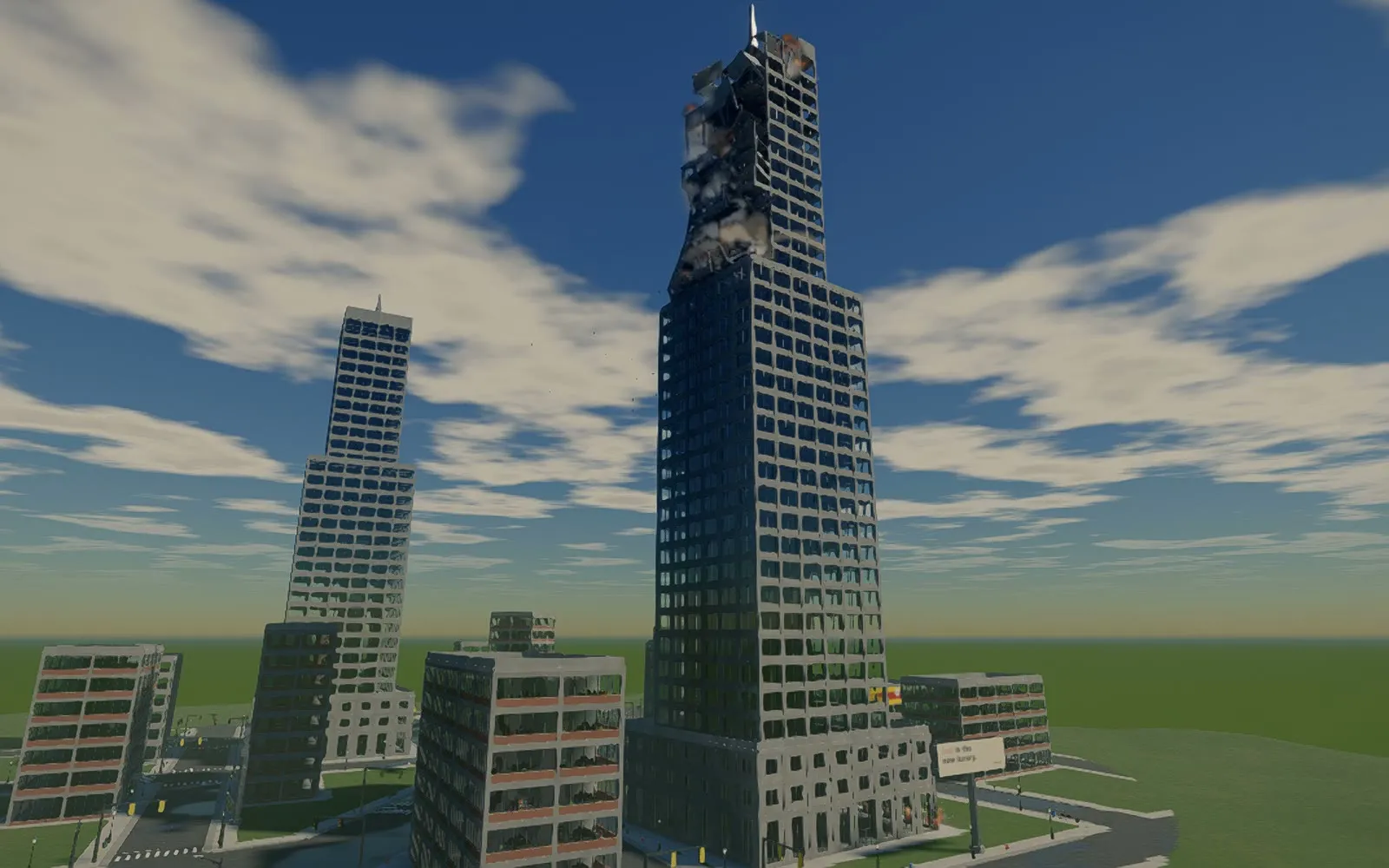 LOOP 0:11
What we accepted
After review on October 7, the tower’s fall and the crush of the top section at the end, the part that mattered most, both held up. A small jump remains at the onset, and we left it there for now.
How this post was made
- Drafted by
- A Claude Code session in the trilithon.games repository, October 10, 2026, working from the game's changelog, docs and tracker.
- What it did
- Drafted this post from the game's changelog and the studio's dated design notes, and checked each number against them.
- Reviewed by
- Alex van Rossum,
On the roadmap: City depth
Linear MIP2-265, MIP2-269, MIP2-275, MIP2-276, MIP2-566