Fly low: why the ceiling is 2.5 stories
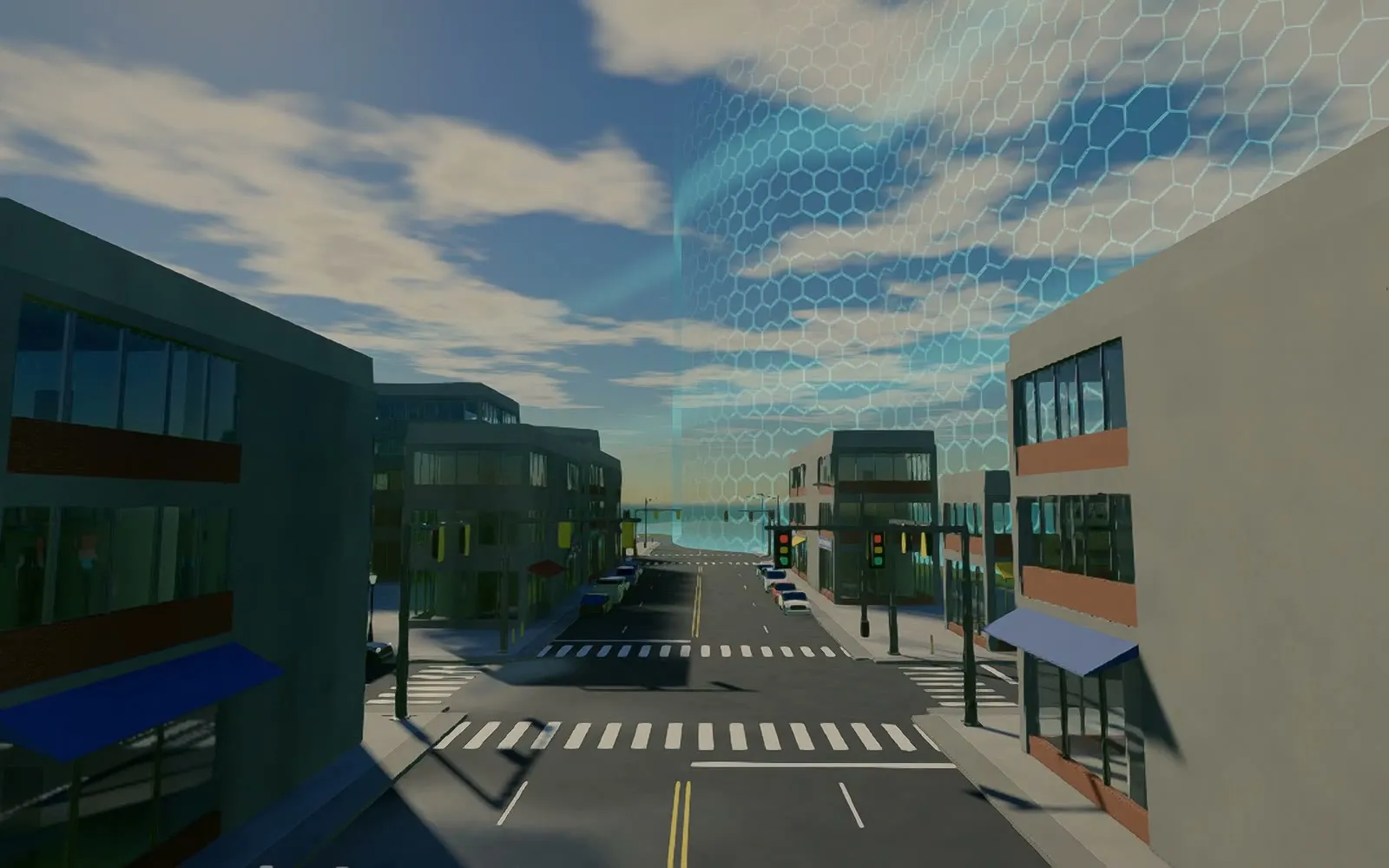
We made the decision on October 1, 2026. This post also follows what the limit meant for the game’s cities and cameras through October 7.
What we found
In the sandbox, flight stayed low, at a self-imposed maximum height of about 2.5 stories, and play at that height was more dynamic than higher up. We marked it as the high point for the dogfight, and possibly for the whole game, because blowing up a building from high up does not come close to looking up and seeing it come down.
The ceiling
We made about 2.5 stories the dogfight’s ceiling, and the chase camera was set at street level to match. At roughly 4 m a story, that is a ceiling of 10 m over the ground under the ship. Climbing fades out over the last 2 m, so the ship eases into the limit. The chase camera sits 12 m behind the ship and stays among the buildings under the ceiling.
What the ceiling does to a city
The city has to work at that height. Storefront strips along the streets are one or two stories. A one-story strip stands 5.1 to 6.2 m, and a two-story strip 8.6 to 10.1 m. The enemy pilots cruise at 6 m, so they see and shoot over a one-story strip and meet a two-story one as a wall. A ship at the ceiling sees over almost every strip to the 5 to 10 story buildings behind.
As of October 4, too many buildings sat below the ship in flight. The tight city, with short buildings in front of taller ones, was built to fix that. We wanted to keep the open streets, since seeing something at the end of a street and going after it is part of the appeal, and the cities might need to be larger. Smaller ships and a lower ceiling were another option, but they would conflict with the “overstreet” designs.
We built a second mix of the tight city, with strip buildings of 2 and 3 stories and roofs 9 to 13 m up, to fly against the first on the same seed. On three test seeds, the share of street frontage walled off at a ship’s height went from between 36 and 41% to between 69 and 70%. The old wooden houses already fit the ceiling and stayed as they were. On October 7 we decided to keep both street-front mixes.
Flying under and around
We wanted ships to be able to fly under and around the elevated roads, except where there is an off-ramp. The raised street’s underside is 13 m up, above the ceiling, so ships can fly beneath it.
The ceiling is measured from the ground under the ship. After a ship flew into a ramp, we made the solid mass under the ship, meaning roads and low roofs, the ground that sets the maximum height. The 10 m is now measured from a raised street’s deck or ramp, or from a roof at most 10 m over the terrain. Taller roofs still wall the fight in.
Cameras
On October 4 we also added several camera positions for play. The game now has Chase, Close, Far and Nose, and a field-of-view setting from 55 to 85 degrees, 70 by default. Far sits 17 m back and 7 m up and looks down the street ahead. On October 7, we moved the camera to Far, widened the field of view, and kept both.
How this post was made
- Drafted by
- A Claude Code session in the trilithon.games repository, October 10, 2026, working from the game's changelog, docs and tracker.
- What it did
- Drafted this post from the game's changelog, design docs and the studio's dated design notes, and checked each number against them.
- Reviewed by
- Alex van Rossum,
On the roadmap: Ships and the city dogfight
Linear MIP2-191, MIP2-344, MIP2-455, MIP2-463, MIP2-465