An elevated freeway for the wide city
What we wanted
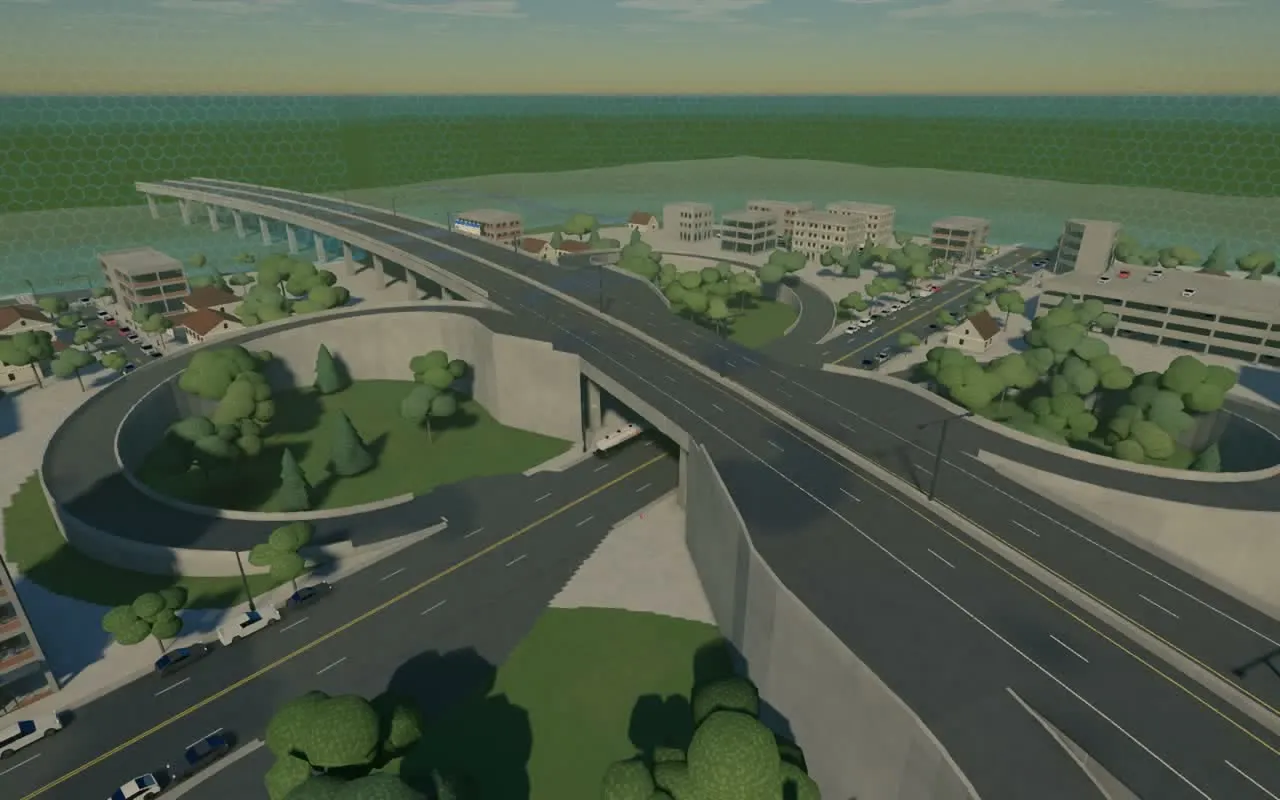
The tight city had a raised street on columns that sloped down into the city at both ends. We wanted something closer to a real highway, one that curves and runs out past the edge of the city instead of dropping into it, and looks like a freeway rather than bare concrete. The enemy pilots also flew badly underneath it, worst where it sloped down. And we wanted to be able to get onto it, with solid ramps that come off a street at an intersection.
The freeway
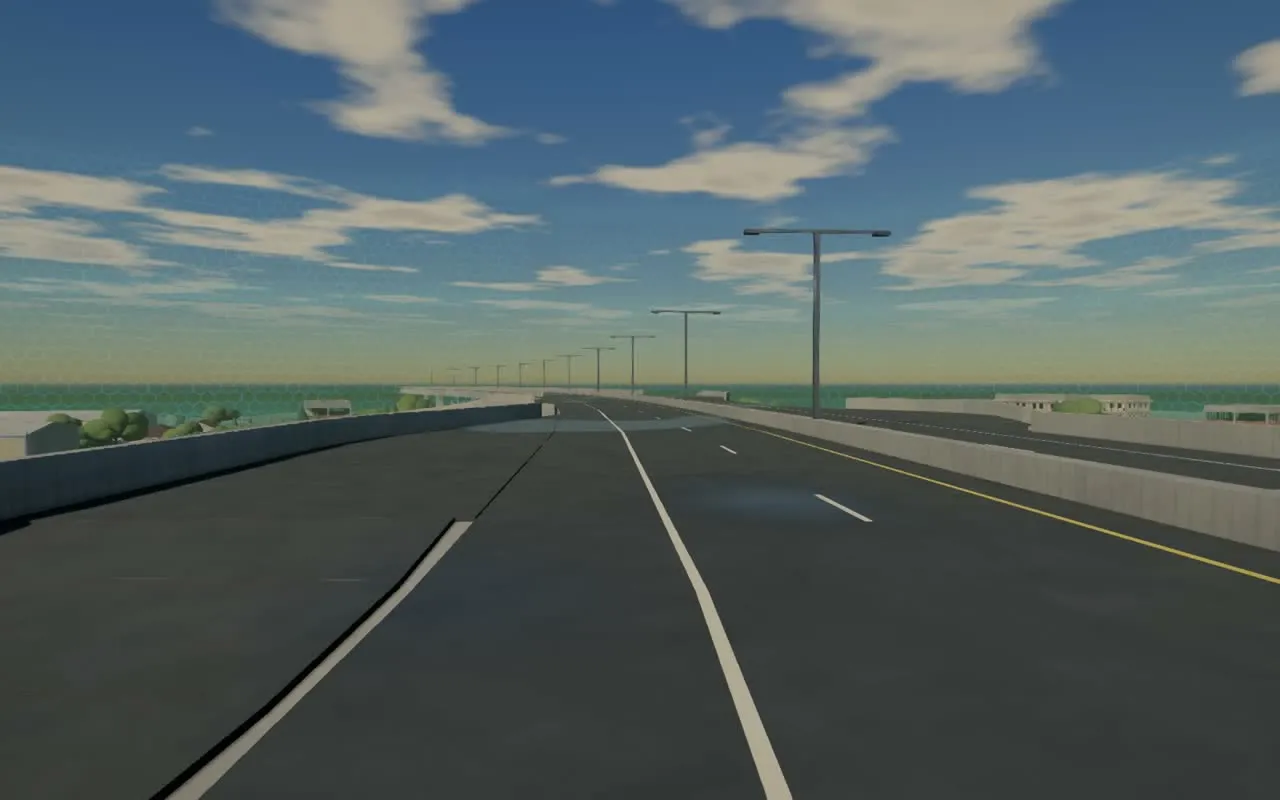
The freeway is built to the numbers of real elevated freeways and the standards they follow: two lanes each way on a deck 25.3 m wide, two columns per support standing 8.1 m either side of the middle, nine girders under the deck, a span every 24 m or so, and the underside 13 m up. That is above the ships’ 10 m flying ceiling, so a ship can fly under it anywhere and only has to avoid the columns.
Every piece of a building in this game is a convex solid, a shape with no dents, because that is what the physics engine handles well. A curve is made the way real ones are: straight spans, each support turned to split the angle between the spans either side of it, and the deck pieces over each support cut to follow both.
The first layout put a girder over each column. The game’s load model checks every contact between pieces against its strength, and those contacts carried 1.16 to 1.20 times what they could hold. Losing one support brought the whole freeway down. Moving the girders so each one frames into a beam instead brought the worst contact to 0.60, and losing a support now drops just the two spans beside it.
Fitting it into a city
The freeway goes into a new kind of city, wider and more spread out, 375 m across from the middle to the edge. Its line is a gentle curve through the middle, running out past the edge each way. The city builds around it: buildings under the deck are dropped, and the supports are placed over the whole line at once to keep their columns out of the streets. Placed one at a time, 10 to 15% of the columns stood in a road; over the whole line, 5 to 8% do. The rest stand where a road crosses at an angle too long for any span, as real ones do.
The cloverleaf
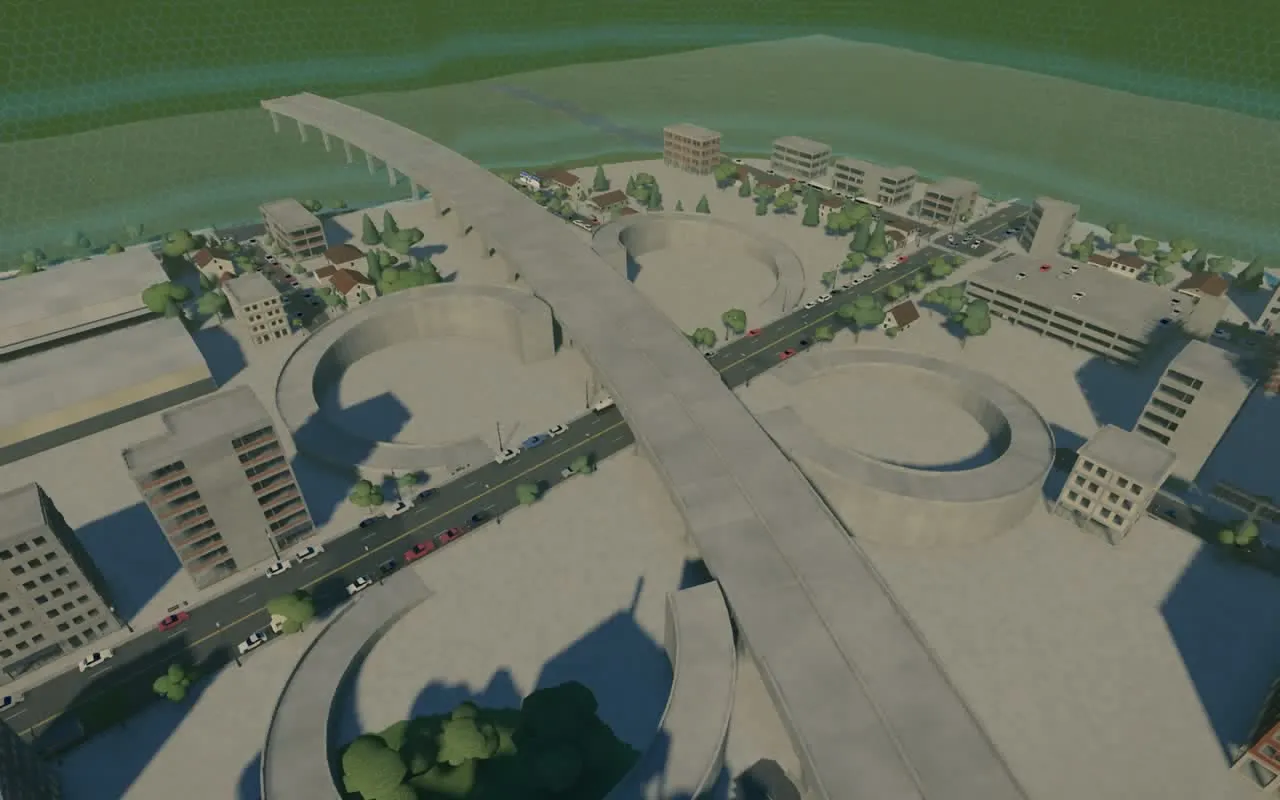
The ramps are loops, as on a cloverleaf interchange: a ramp of solid fill around a 32 m circle in each corner of a crossing. Each loop touches the street’s edge at the ground and the deck’s edge at the top, and climbs the long way round, about 240 to 290 degrees on the cities measured, at 10 to 12%.
Three things had to be found by trying. The freeway crosses most streets at about 45 degrees, and in a 45 degree corner a loop that touches both roads sits about 130 m out, across other streets, so no city found room for one. The interchange now goes where a street crosses nearly square. The freeway also curves: a loop fitted to the deck’s direction at the crossing pushed up to 2 m into the deck by the time it reached it, so each loop slides along its street until it meets the curved edge exactly. Finally, the loops near the middle of the city took the tower lots with them, and with them the city’s height, so the interchange is placed about halfway out.
The first loops met the deck and the street at a single point each, which left nowhere to merge, on or off. Each loop now has a merge lane beside the deck that tapers into it, and another at street level, where the curb opens and nothing is parked.
Does it make the pilots stupid?
Twelve computer-flown duels on open ground with the freeway through the middle, against the same twelve without it: every fight crossed under the deck, 12% of the flying time was spent beneath it, and no ship stood still longer than a second. The ships bumped walls 159 times against 138 without the freeway, the difference being the columns.
How this post was made
- Drafted by
- A Claude Code session in the game's repository, October 9, 2026.
- What it did
- Researched real elevated freeways, built the freeway, its supports and the cloverleaf ramps, ran the duels, and drafted this entry for the dev journal.
- Reviewed by
- Alex van Rossum,
On the roadmap: The run: a ladder of cities
Linear MIP2-703commits 1690cd0, 6cfe647, c037b21, b0504d3, e2b922e, 51e9469, cbd1e1e, b094415