Cheats we measured, and the ones that didn't help
Where the budget ran out
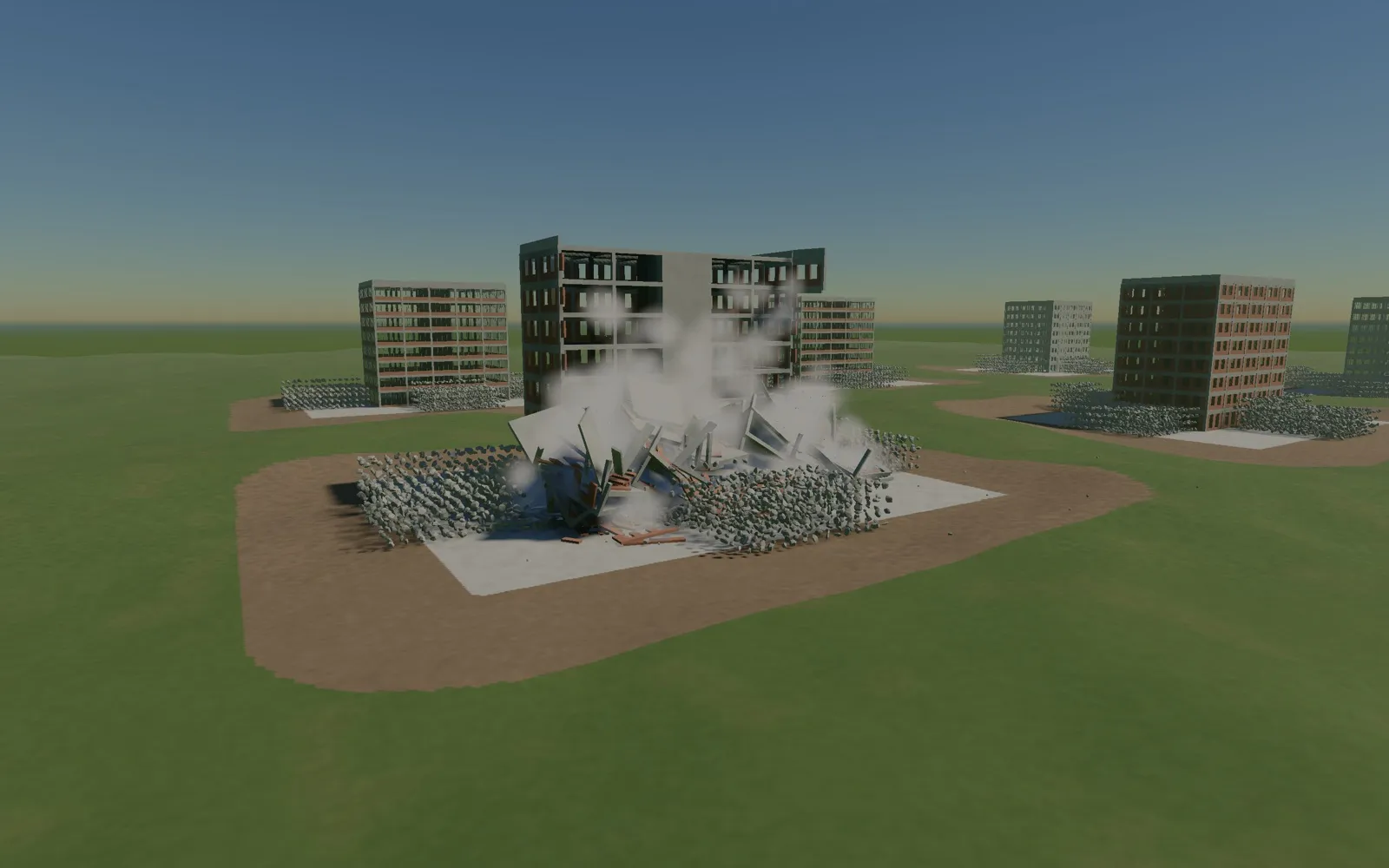
On September 29 the engine got a density ladder: scenes that put 2, 4, 9, 16 and 25 copies of the same office on one site and blow the front columns of every building at once. This first run was at full power with the machine in use, so it places the limit roughly.
| Offices | Bodies at the end | Physics p95 | Frame p95 |
|---|---|---|---|
| 2 | 2,611 | 2.13 ms | 5.03 ms |
| 9 | 16,559 | 8.86 ms | 13.01 ms |
| 25 | 43,238 | 25.04 ms | 39.75 ms |
p95 means 95% of steps or frames were faster than the figure. The gates are 6 ms for physics and 12.5 ms for the frame, so nine offices at once is the first rung over. The graphics chip stays at 5 to 7 ms on every rung, so the frame follows the physics step. A profile of the nine-office collapse put the cost in the number of moving bodies and their contacts. Finding collisions took 55% of the physics library’s work.
We wanted to know whether physics cheats, rendering cheats or low-resolution tricks could keep the dense rungs smooth. Research covering physics, fracture and debris, rendering, and design and platform produced one ranked list of ideas.
Four ideas that did not help
The research ranked the first three of these at the top, and we measured each before keeping it. The first two used a spree of 60 charges across the 25-office rung. The third used the rung’s demo.
A separate layer for light fragments. Pieces under 25 kg would skip collisions with each other. At the low tier, physics p50 went from 20.5 to 25.2 ms and steps over 8 ms from about 1,200 to 1,356. More of the buildings came down (29,179 members against 27,638) and more bodies stayed awake at the end (841 against 285), because light pieces sank through each other onto standing floors and loaded them more directly. We canceled it.
Frozen rubble in the static part of the collision tree. About 30,000 frozen pieces were sitting in a part of the tree that the physics library updates every step. Moving them to the part for immovable bodies gave physics p50 of 13.0 ms before and 12.0 to 14.0 ms after. There was no repeatable difference, so we canceled it.
One release budget per step. Limit how many pieces can break loose in one step across all buildings and hold the rest back. Physics p95 was 18.6 and 19.2 ms with no budget, 19.1 ms twice with 400 a step, and 18.9 ms with 1,000. The slow steps come from thousands of bodies that stay awake for seconds, and a budget on releases does not change that. We canceled it.
Frozen rubble merged into static piles. This one was measured before it was built. With 600 moving pieces over 6,000 frozen ones, merging would save about 0.03 ms a step at p50, so we did not build it.
What helped
Detail by distance. Detail gets coarser far from the camera. Past 90 m, a charge breaks members into a share of their cells that falls with distance, to 0.35 at 257 m and beyond, and a far collapse comes down in bigger chunks. On the 25-office rung, physics p95 went from 18.6 and 19.2 ms to 7.7 and 8.2 ms, and steps over 8 ms from 514 and 520 to 72 and 96. The same buildings came down.
Gas lines. Secondary explosions, like gas lines going off, become part of a building collapse. They vaporize falling chunks without adding force, so there are fewer parts to track. In scene 8, 11 blasts vaporized 120 members and collapse physics went from 1.06 to 0.50 ms p50, with 1,136 bodies left against 1,596. The blasts also changed the collapse, with 1,308 members falling against 920.
A rocket hopper. We wanted a reload time on large weapons. The hopper holds six rockets and loads one a second. In a spree of 8.4 m charges across the 25-office rung, physics p95 was 12.56 ms with the hopper and 43.37 ms firing one every 0.2 s, and 23,229 pieces were made against 42,133.
Slow motion. When a physics step costs more than 12 ms, the game clock slows so the steps fit in real time and the frame rate holds. A 24 ms step runs at half speed and 48 ms at a quarter, the floor. The rules follow EVE Online’s time dilation, which slows the game clock when a server overloads. We wanted explosions to stay solid in slow motion so it does not look cheap. The first threshold was 8 ms, and the game stayed in slow motion long after a collapse, since settling rubble keeps steps over 8 ms for a long time (998 of 1,500 steps in one tower test). The threshold became 12 ms.
Not yet helping
Physics smoothing was among the first cheats proposed. A setting turns it on or off and caps how many ticks it may skip. Under load, physics steps every 2 to 4 ticks and the game draws bodies between their last two poses. A step covering two ticks cost about what two steps do (8.30 ms a tick at a gap of 1, 8.06 at 2, 8.95 at 3 in the 25-office demo), and the longer steps pressed more pieces into the ground. It stays in as an option while it is tried in play.
How this post was made
- Drafted by
- A Claude Code session in the trilithon.games repository, October 10, 2026, working from the game's changelog, docs and tracker.
- What it did
- Drafted this post from the engine notes, the cheats research file and the changelog, and checked each number against them.
- Reviewed by
- Alex van Rossum,
On the roadmap: Pressure testing
Linear MIP2-231, MIP2-246, MIP2-247, MIP2-248, MIP2-249, MIP2-257, MIP2-259, MIP2-260, MIP2-261, MIP2-267