A building that falls on the ship now hurts it
What we wanted
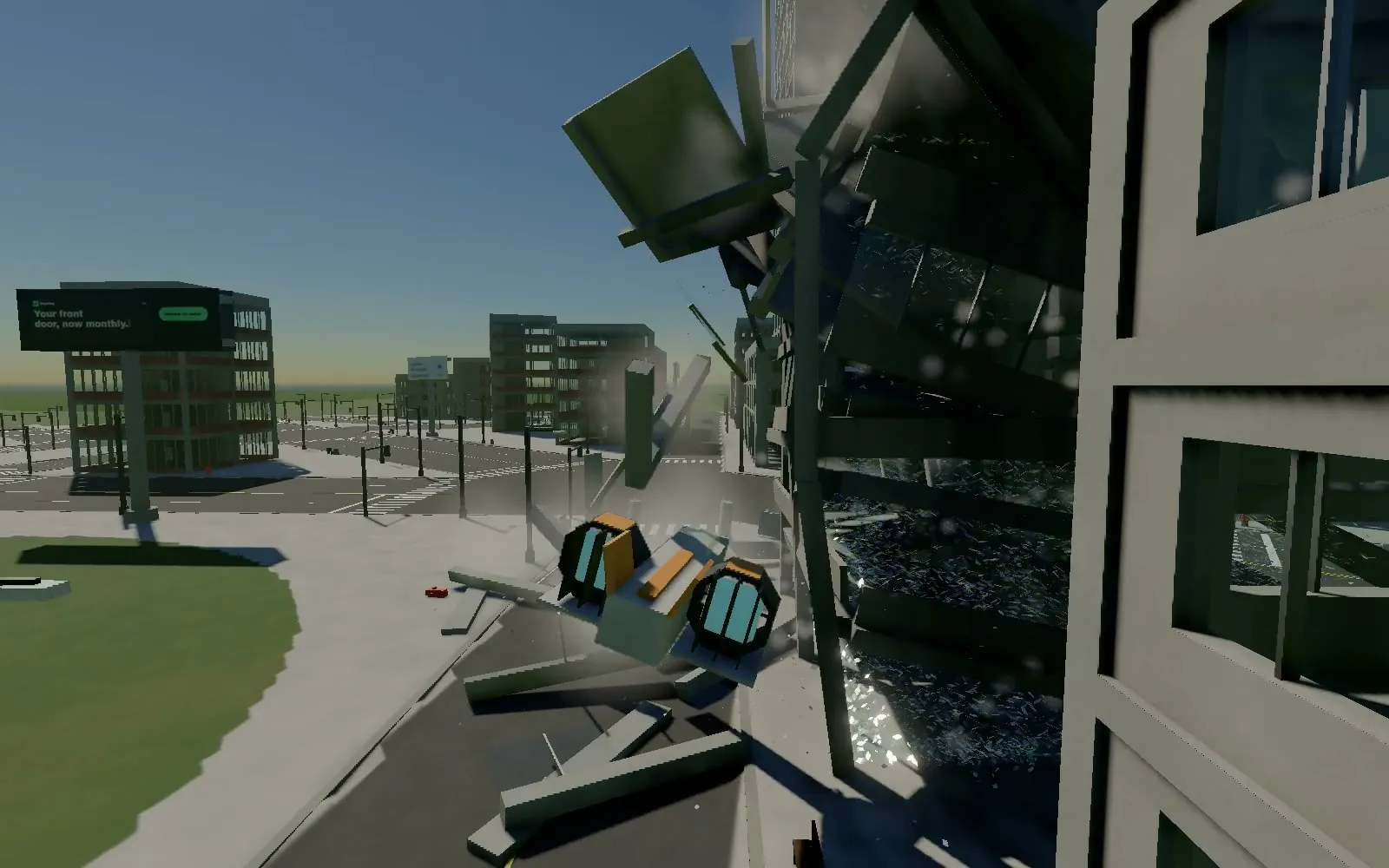
A ship took almost no damage when a whole building fell on it. On October 9 we decided it should take far more, and that a floor falling on the ship should do some damage. Enemies should take the same damage, so a collapse works as a weapon against them, and ramming a car or debris should hurt the ship no more than it did.
What we measured
In the damage code, a ship was hurt only by the speed a physics step took off it: a loss of more than 8 m/s counted, each m/s beyond that cost 0.015 of its health, one blow took at most 0.35, and blows were at least 0.4 seconds apart. Something heavy that stops a ship gradually, or pins it, did nothing.
A probe dropped a 26 t slab from 14 m onto a hovering ship. The slab took 11.5 m/s off the ship in one step, which cost it 5% of its health. The slab then pinned the ship to the street and did no more damage.
Weight on the ship
The first change made weight count. Every other step, the ship takes 0.12 of its health per second for each ship’s weight of bodies pressing down on it from above, up to 0.6 a second, and the shield goes first. Only bodies at least half the ship’s own mass count. The slab weighs 4.7 times the ship and leaves it at about 0.02 of its health after 3 seconds. A 77 kg piece dropped on the ship leaves it whole. Enemies take the same damage.
A first guess that was wrong
The first guess at what was still missing came from reading the code, before any probe of a falling tower, and it was wrong. A probe under a tower showed the cause. A tower that comes down as a mass presses on what is below with its stories, which the game moves along set paths in place of letting physics move them. The collision query still weighs them, at 2,700 to 5,100 t, which is 500 to 930 ships. At the 0.6 a second cap, a shielded ship in the lobby of a 24-story tower outlasted the fall. It ended at 0.44 of its health, pushed 5.8 m into the ground.
The cap on the rate was too low for that much weight. A weight of 100 ships or more now flattens a ship at once, shield included. In the test, the ship’s crash ends 0.63 seconds after the tower’s mass starts down, where the ship was hovering.
Only what came down counts
A body counts as crushing only once it is seen pressing on the ship while moving down faster than 0.5 m/s and touching within 2 cm, and it keeps counting as long as it keeps pressing. A slab that lands, pins the ship and comes to rest still crushes it.
A review found two cases that should not count, frozen rubble that the ship rises into and other ships, and tests cover both. A ship that climbs into a standing slab or into frozen rubble for 3 seconds comes out whole, and a ship that comes down on top of another for 3 seconds leaves that one whole.
A felled chimney
A later probe cut a 110 m chimney on one side, with a gunship hovering 3 m up at 30, 50 and 70 m along the fall. At all three spots the falling blocks landed on it. Each block weighs 25 to 38 t, and up to seven landed on the ship at once. The ship was bumped and then crushed at the 0.6 a second cap, and its crash ended 1 to 1.5 seconds after impact, within a few meters of where it hovered. The rules needed no change. The three numbers behind the rule are left for us to tune: 0.12 a second per ship’s weight, the 0.6 a second cap, and the 100 ships’ weight that flattens a ship at once.
How this post was made
- Drafted by
- A Claude Code session in the trilithon.games repository, October 10, 2026, working from the game's changelog, docs and tracker.
- What it did
- Drafted this post from the game's changelog and the tracker issue's build reports, and checked each number against them.
- Reviewed by
- Alex van Rossum,
On the roadmap: The run: a ladder of cities
Linear MIP2-681commits 174abec, b8c3c41